Nabil Assaf and a Regional Responsibility That Goes Beyond Agriculture
Food is no longer simply a matter of agriculture, production, and crops in today’s world. Nor is food security merely about a country’s ability to provide enough food for its population. The equation has become far more complex, with food increasingly linked to water, climate, the environment, energy, the economy, social stability, and the future of communities.
From this perspective, the role of the Food and Agriculture Organization of the United Nations (FAO) in Tunisia takes on particular significance. Agricultural challenges intersect with growing pressures on water and natural resources, as well as with the need to develop food systems that are more resilient and better able to respond to climate and economic transformations.
Tunisia has added regional significance as it hosts FAO’s Subregional Office for North Africa, alongside the Organization’s country office. This makes Tunisia an important platform for coordination, knowledge exchange, and joint action on issues that extend beyond the borders of any single country.
Nabil Assaf… From Experience to Regional Responsibility
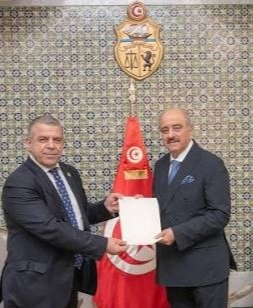
At the heart of this landscape stands Nabil Assaf, who serves as FAO’s Subregional Coordinator for North Africa.
A Lebanese national, Assaf has built a long professional career within FAO, working on issues related to the environment, forestry, and natural resource management. He served at FAO’s Subregional Office for North Africa in Tunis and later assumed responsibilities as the Organization’s Representative in Algeria before taking on his current regional role.
The significance of this responsibility lies in the fact that it extends well beyond agriculture in its traditional sense. It encompasses a region facing a common set of interconnected challenges: water scarcity, drought, climate change, land degradation, mounting pressure on natural resources, and the growing need to secure food for future generations.
This regional responsibility therefore calls for a vision that transcends national borders and seeks opportunities for cooperation, knowledge-sharing, and the development of practical solutions.
Tunisia… More Than a Headquarters
The presence of FAO’s Subregional Office for North Africa in Tunisia is more than an administrative address. Tunisia represents an important space for cooperation and coordination across North Africa, a region that needs greater collaboration on agriculture, water, the environment, and food security.
In Tunisia, FAO works with government institutions and partners from the private sector, civil society, and research institutions in areas that include agricultural policy development, support for small-scale producers, natural resource management, sustainable fisheries, and strengthening the role of women and young people in rural areas.
This approach places the Organization increasingly in the position of a partner in developing solutions, rather than an institution whose role is limited to providing assistance.
True food security does not simply mean that consumers can find food on supermarket shelves. It also means that communities have the capacity to produce their own food, that supply chains are resilient enough to withstand crises, and that natural resources are managed in a way that does not undermine the rights and needs of future generations.
Water… The Silent Battle
If there is one issue that will shape the future of North Africa, it is water. Drought, climate change, declining water resources, and rising demand for food are turning water into an issue that goes far beyond agriculture. It has become an integral part of economic and social security and national stability.
In Tunisia, efforts to improve water management, increase water productivity, and protect natural resources are particularly important. These challenges require cooperation among national institutions, international organizations, research centers, and experts.
Here, the role of a regional coordinator can extend beyond administrative coordination, helping connect expertise and experiences across North African countries and drawing on successful Arab, Mediterranean, and international approaches to drought and water scarcity.
From the Field to the Market
Agriculture does not begin and end at the farm gate. Farmers need knowledge, technology, and financing, but they also need fair markets, efficient distribution channels, and the ability to reach consumers.
For this reason, no food-security strategy can succeed if agricultural producers remain outside the center of attention.
Supporting small-scale farmers, empowering young people and women in rural areas, developing value chains, and improving access to markets are all essential elements of agricultural development that is more closely connected to people and better able to create genuine economic opportunities.
This reflects a different approach to agricultural development: the farmer is not merely a producer, but a partner in building food security.
A Responsibility Beyond the Office
The importance of Nabil Assaf’s position lies not only in the nature of his mandate, but also in the timing. North Africa is entering a phase that requires more integrated policies, because issues that were once addressed separately have become so interconnected that they can no longer be treated in isolation. Water is linked to food. Food is linked to climate.
Climate is linked to the environment. And the environment is linked to the economy and social stability.
The success of FAO’s regional role therefore depends on genuine partnerships with governments, universities, research centers, the private sector, and civil society. Most importantly, it depends on engaging with the people who experience these challenges every day: farmers, fishers, rural women, and young people seeking opportunities.
From Tunisia to North Africa
Perhaps the greatest value of FAO’s presence in Tunisia lies in its potential to turn the country into a platform for regional dialogue, expertise, and cooperation.
The objective today is not merely to implement projects, but to build shared knowledge, exchange expertise, and transform successful local experiences into models that can be adapted and applied in other countries.
In this context, Nabil Assaf’s responsibility extends beyond managing programmes or overseeing projects. It is a responsibility to contribute to shaping a regional vision that treats food, water, and the environment as interconnected components of a single challenge.
Putting People at the Center
Ultimately, the success of any organization cannot be measured solely by the number of programmes it implements or meetings it holds. Its true value is measured by the impact those efforts have on people’s lives. Has the farmer become better equipped to cope with drought? Has agricultural production become more sustainable?
Have young people in rural areas gained new opportunities? Has water management improved? Have communities become more resilient in the face of crises? These are the questions that will determine the value of regional efforts in the years ahead.
From Tunisia, where national expertise meets regional responsibility, the Food and Agriculture Organization faces a genuine test: How can knowledge, expertise, and international partnerships be transformed into tangible solutions that safeguard food, water, and the environment, while giving people across North Africa a better chance at a secure future?
This is precisely where the importance of Nabil Assaf’s role becomes evident. The responsibility he carries today does not stop at the boundaries of agriculture. It extends to one of the most sensitive questions shaping the region’s future:
How can we ensure that food remains available, water remains protected, and the land remains capable of giving?
It is the battle for the future… and it may begin in the field, but it certainly does not end there.
TunisianMonitorNews (By: Bassam Bani Ahmed)