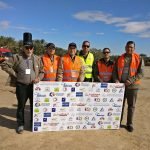
“Heritage and the Art of Architecture” is the theme of the 35th edition of Tunisia’s Heritage Month, which was officially launched Saturday evening by Culture Minister Amna Srarfi from the city of Testour in the governorate of Béja. The city was chosen as a model of Andalusian architecture and its transmission and influence in Tunisia.
Andalusian architecture reached its peak between the 10th and 15th centuries, particularly under the Umayyad rule in Al-Andalus, in a context of cultural interaction between Islamic, Byzantine, Gothic, and local Iberian elements.
Moriscos and their architectural impact in Tunisia
That golden age gradually came to an end with the fall of Granada in 1492, leading to the forced displacement of the Moriscos. Between 1607 and 1609, an estimated 80,000 Moriscos settled in Tunisia, bringing with them knowledge of architecture, agriculture, and crafts. They founded new towns, including Soliman, Béli, Niano, Grombalia, Turki, El Jedid, Zaghouan, Tebourba, Majaz al-Bab, Testour, Sallouqia, and Al-Alia.
Architecture attributed to the Andalusians in Tunisia can be classified into two types. One is heavily influenced by the local Tunisian model, using traditional materials and methods while enriching local building techniques. The other, more authentic, displays a clear Andalusian/Spanish influence, especially in dwellings with a European character.
‘Path of the Andalusians’: a new cultural tourism route
In her opening address for Heritage Month, which runs until May 18, Minister Srarfi stressed that the choice of “Heritage and the Art of Architecture” as this year’s theme reflects a belief in the value of architecture and its importance as a vital component of Tunisia’s history and a living product of its successive civilizations and cultures.
She explained that the carefully chosen theme is also an invitation — especially to young people — to discover the secrets of this cultural heritage, explore its origins and roots, and develop a genuine understanding through a fresh, contemporary perspective on the creative features that distinguish each architectural style.
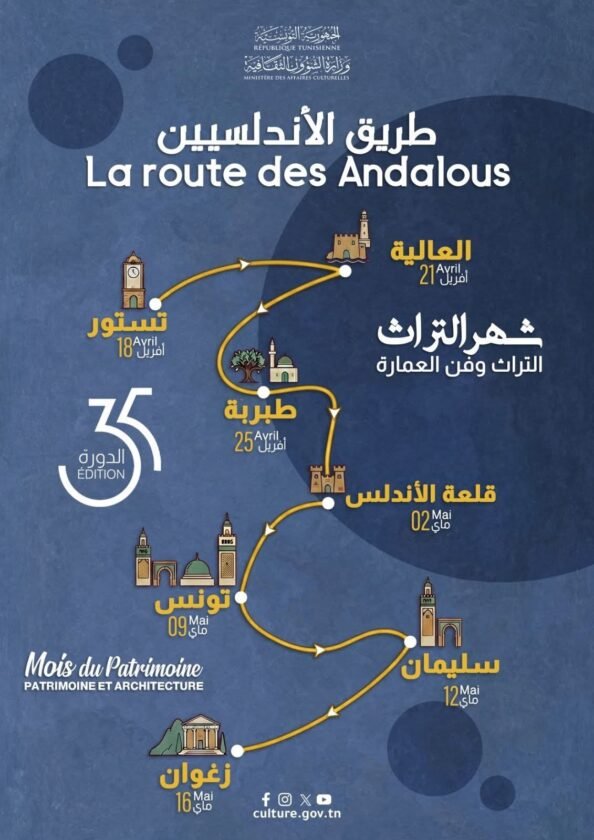
To enrich the main theme, the minister inaugurated the “Path of the Andalusians,” a cultural and tourism trail aimed at raising awareness of cities linked to the history of the Andalusian presence in Tunisia, their cultural and civilizational legacy, and their memory. The route includes Testour, Tunis, Al-Alia, Kalaat Al-Andalus, Tebourba, Soliman, and Zaghouan.
Intellectual, cultural, and artistic program
The event, which kicked off at the “Café Al-Andalus” cultural space and was attended by members of the diplomatic corps accredited to Tunisia as well as journalists, featured a presentation on architecture — with Testour as a case study — by Professor Fawzia Ben Zahra, who gave an overview of restoration work in the city. Professor Zouhair Ben Youssef also delivered a talk on Andalusian influences in Béja, using Testour as an example.
The entertainment and artistic program, which drew large crowds of local residents, included a 3D light projection show on the facade of the Great Mosque and its surroundings, an animated segment on Andalusian customs, rituals, and crafts, accompanied by a tasting of traditional Andalusian dishes — particularly banadij. The evening concluded with a performance of Malouf music.
TunisianMonitorNews (Dhouha)