Tunisian-Japanese cooperation on climate action continues to advance through the Joint Crediting Mechanism (JCM), which has led to the approval of six projects in Tunisia, including five renewable energy projects and one waste management project. These initiatives aim to reduce greenhouse gas emissions and support Tunisia’s energy transition.
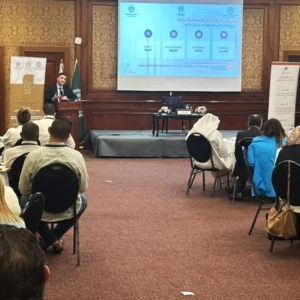
In this context, Akihiro Takazawa, Counsellor at the Embassy of Japan in Tunisia, participated on October 7 in a national workshop on “Tunisia’s Access to Climate Finance,” organized with the support of the United Nations Development Programme (UNDP) and initiated by the Ministries of Foreign Affairs, Migration and Tunisians Abroad; Environment; Finance; and Economy and Planning. During the workshop, the Japanese diplomat delivered a presentation on Japan’s activities and financial contributions under the Joint Crediting Mechanism.
Launched by the Japanese government in 2013, the JCM aims to promote the deployment of advanced decarbonization technologies and contribute to achieving the objectives of the Paris Agreement on climate change. The mechanism is based on bilateral cooperation between Japan and partner countries, supporting greenhouse gas emission reduction projects through technology transfer and financing. The resulting emission reductions are jointly measured and converted into carbon credits shared by both parties.
Japan began implementing the mechanism through an agreement with Mongolia in 2013. Since then, the initiative has expanded to include a network of 32 partner countries. Tunisia officially joined the mechanism on August 26, 2022, coinciding with the eighth Tokyo International Conference on African Development (TICAD 8), hosted by Tunis.
The approved projects in Tunisia include photovoltaic solar power plants in Sidi Bouzid, with capacities of 50 and 100 megawatts (MW); Tozeur, with a capacity of 50 MW; and Gabès, with a capacity of 130 MW. The portfolio also includes a project in the governorate of Béja that applies the Fukuoka Method of waste management, using semi-aerobic landfill technology.
The latest approved project involves the construction of a 75 MW wind power plant in El Fahs, in the governorate of Zaghouan, through a partnership between Aeolus and Scatec. The project is expected to contribute to diversifying Tunisia’s energy sources and increasing the share of renewable energy in its energy mix.
These initiatives reflect the growing focus of Tunisian-Japanese cooperation on leveraging technology and financing to address climate priorities, strengthen Tunisia’s efforts to reduce emissions, and accelerate its transition towards a more sustainable energy system.
TunisianMonitorNews (Douha Essaafi)