Ahmed Maher: “My Mother Brilliantly Imitated Umm Kulthum, Sabah, and Asmahan”
Ahmed Maher: “I Cried Outside the National Theatre Until I Secured a Military Service Deferment”
As part of the 19th edition of the Egyptian National Theatre Festival, chaired by actor Mohamed Riad, a seminar was held to discuss the book Ahmed Maher: The Knight of Arab Theatre, published in the festival’s series honoring this year’s distinguished artists. The event was attended by the celebrated actor Ahmed Maher, moderated by critic Asmaa Hegazy, and featured remarks by the book’s author, journalist and theatre critic Gamal Abdel Nasser.
Opening the session, Asmaa Hegazy welcomed the audience, describing the discussion as particularly meaningful because it celebrated an exceptional artist, director, mentor, and teacher whose influence has shaped generations of performers. She noted that the title The Knight of Arab Theatre was far more than a ceremonial label—it truly reflected Ahmed Maher’s character and artistic stature.
Hegazy admitted that, for the first time, she felt nervous while standing on stage, explaining that Maher’s life is filled with remarkable stories worthy of being told. She praised him as both an artistic and human role model whose legacy extends beyond his rich body of work to the profound impact he has left on colleagues and audiences alike.
She reflected on Maher’s childhood in the working-class district of Bulaq Abu El-Ela, emphasizing how the neighborhood shaped his personality, courage, and unwavering commitment to speaking the truth. She also recalled the phrase that guided him throughout his journey: “My Lord, You are my only mediator.”
Before welcoming Maher to the stage, Hegazy remarked on his commanding presence during the festival’s opening ceremony, praising both his eloquent command of the Arabic language and his remarkable charisma. She then asked him about the role his mother had played in his life, particularly since she possessed considerable artistic talent but never pursued a professional career.
Maher responded emotionally, saying that any conversation about his mother inevitably carries a deep sense of longing.
He revealed that before his birth, his mother had lost two children. She later told him that she climbed to the rooftop, uncovered her head beneath the sky, and prayed: “Take my eyesight, but let this child live.”
He added that during her pregnancy she often joked with relatives, saying, “The baby in my womb isn’t human—he’s a puppet, constantly moving and never letting me sleep.”
Maher explained that his family often compared his mother to actress Lebleba because of her extraordinary gift for impersonation.
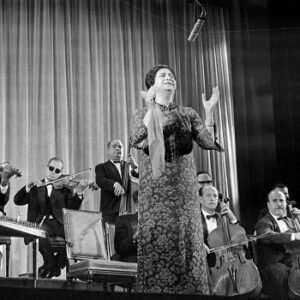
“My mother was astonishing at imitation. When she sang Umm Kulthum’s songs, she became Umm Kulthum. The same happened when she sang Sabah or Asmahan.”
He said that, despite her remarkable talent, his mother’s Upper Egyptian family feared she might pursue an artistic career and therefore insisted she remain at home after finishing high school.
“She used to sing while breastfeeding me,” Maher recalled. “If her thoughts wandered and she stopped singing, I would immediately stop nursing and cry until she resumed singing. Then I would continue feeding. As I grew older, I became inseparable from our family’s radio.”
Maher said that his love for art was nurtured from an early age through visits to the theatres of Rod El-Farag, where he watched performances by the late Mahmoud Shokoko, singer Nagat El Saghira, actress Lebleba, and many other stars.
Returning home, he would transform a table into his own stage, gather neighborhood children—”whether they wanted to or not,” he joked—and perform everything he had memorized before receiving enthusiastic applause.
During his school years, Maher joined the choir, the travel club, and the drama team. At one celebration marking the Prophet Muhammad’s birthday, he was cast as Abu Talib, the Prophet’s uncle.
“My teachers used to say I wasn’t a child,” he laughed. “They said I was a grown man trapped in a child’s body because my voice sounded nothing like that of a little boy.”
In secondary school, Maher became head of the drama team, overseeing every aspect of the productions and embarking on what he described as joyful theatrical adventures.
“My passion for acting had a tremendous impact on my life,” he said. “My obsession with theatre kept me in high school for four years. One day my mother came to me and said, ‘Have mercy on your father. He’s heartbroken every year because you fail.’”
“In my fourth year I finally decided to pass. As Hamlet said, ‘To be or not to be.’ I succeeded—but only because God stood by my side. Otherwise, I certainly would have failed.”
Maher’s determination to join the Higher Institute of Dramatic Arts marked the beginning of his professional journey. However, his dream nearly collapsed when he was informed that he first needed to settle his military service status. Compounding the challenge, his father regarded actors merely as “performers” whose opinions carried little weight.
Feeling desperate, Maher found himself standing before the National Theatre, where he broke down in tears.
“I cried there without knowing what to do,” he recalled. “When I came to my senses, it was dawn and the streets were empty.”
The following day, he decided to visit the Minister of Culture without an appointment.
Staff members mistakenly assumed he was a relative because he insisted on waiting outside the minister’s office. Once the minister emerged, Maher shared his story.
The minister advised him to visit the military recruitment office and apply for a deferment certificate—a request that was ultimately approved.
Maher then sat for the entrance examinations at the Higher Institute of Dramatic Arts, competing against 1,850 applicants, who were eventually narrowed down to 50 successful candidates. He ranked fifth overall.
His audition panel included some of Egypt’s theatre giants, among them Karam Motawie, Nabil Al-Alfi, Hamdy Gheith, Ahmed El-Badawy, Ahmed Abdel Halim, and Zakaria Soliman, then head of the Actors’ Syndicate.
“I had prepared sixteen different scenes,” Maher recalled. “The committee selected two. The first was Al-Fata Mehran. After I finished, the first person to make my heart truly happy was Mohamed Tawfik. Then I performed another scene, and the committee burst into laughter. Mohamed Tawfik jumped onto the stage and embraced me. As I walked out, Dr. Abdel Rahman Arnous congratulated me, saying: ‘Congratulations—you’ve passed.’”
While studying at the institute, Maher participated in numerous productions, beginning with Hamlet, directed by and starring Mohamed Sobhi—a production that critics and professors would later remember as one of the institute’s finest.
Recalling the experience, Maher said: “Mohamed Sobhi inspired us with extraordinary enthusiasm at a time when almost every theatre in Egypt had closed. We were living through the difficult years following the 1967 defeat, and ours was virtually the only theatrical production being staged.”
He praised the late Zosser Marzouk, whom he described as a brilliant artist.
“Zosser secured funding from the Academy and created an unforgettable production. He built the gravedigger’s grave in the front garden before the audience. We later transferred the production to the Egyptian Workers’ Union Theatre, where it was eventually filmed.”
Maher also shared one of his fondest memories from the production.
“One evening, my professor Galal El Sharkawy greeted me warmly while he was accompanied by playwright Naguib Sorour, who knelt down, kissed my hand, and said, ‘He’s my student.’ The audience erupted with excitement throughout the performance.”
Author and theatre critic Gamal Abdel Nasser concluded the seminar by describing it as a privilege to document Ahmed Maher’s artistic and personal journey.
“I thoroughly enjoyed writing this book and every conversation we shared,” he said. “His office is like a museum, surrounded by the costumes, accessories, and memories of the characters he portrayed—from Hulagu to Genghis Khan—and by the legacy of every play he performed.”
Abdel Nasser explained that although he had initially prepared a detailed structure for the book, Maher’s captivating storytelling completely changed his approach.
“I chose to write it almost like a cinematic screenplay,” he said. “When I later gave him the manuscript to review before publication, he told me he found himself laughing and crying at the same time. That was the greatest compliment I could have received.”
He concluded by describing Ahmed Maher’s life as an inspiring story for every young person who dares to dream and possesses the determination to turn that dream into reality.
TunisianMonitorNews