Limited-edition reproductions recreate the colours, textures and brushstrokes of iconic paintings, offering art lovers a new way to experience masterpieces beyond museum walls.
Louvre Abu Dhabi, in collaboration with Lito Masters, has unveiled a limited-edition collection of fine art prints featuring officially authorised reproductions of some of the world’s most celebrated artworks held in the museum’s collection. The selection includes works by renowned artists such as Jean-Honoré Fragonard, Pierre-Auguste Renoir, Piet Mondrian, Katsushika Hokusai and Wassily Kandinsky.
The initiative reflects the museum’s ongoing commitment to making art more accessible to wider audiences and exploring new ways of engaging with cultural heritage beyond traditional exhibition spaces. Through advanced reproduction technology, art enthusiasts can now experience some of the defining characteristics of celebrated paintings in a format designed to bring them closer to their personal spaces.
At the heart of the collection is Lito’s patented Hi-Rnd© three-dimensional printing technology, developed to reproduce artworks with exceptional precision. Going beyond the conventional reproduction of colours, compositions and visual details, the technology recreates aspects of the original paintings’ physical surfaces, including their textures and distinctive brushstrokes.
By reproducing these tactile characteristics, the prints aim to offer a richer visual and sensory experience, allowing audiences to appreciate details that are often difficult to capture through conventional printing methods. The result is a collection that seeks to evoke some of the visual and textural qualities that give each original artwork its distinctive artistic identity.
To ensure the highest standards of accuracy and quality, the digitisation process took place at Louvre Abu Dhabi over three days, using high-resolution scanning equipment specially brought from Austria under the supervision of Lito’s technical experts.
Following the scanning process, the reproductions underwent a thorough review and approval procedure involving the museum’s scientific team, curators and collections management department. This process was designed to verify the accuracy of the reproductions, safeguard the artistic integrity of the original works and ensure that the final prints meet the museum’s institutional standards.
Lamia Al Nuaimi, Director of Development, Marketing and Communications at Louvre Abu Dhabi, described the collaboration as an important step towards making the museum’s collections accessible to a broader international audience. She highlighted how the partnership introduces a new way for people to connect with artistic masterpieces while preserving their essence and bringing them into personal spaces around the world.
Charles Gaucher, Co-Founder of Lito Masters, also expressed his pride in the partnership, noting that the initiative expands access to the museum’s collections beyond its physical walls. He emphasised that the project creates new opportunities for audiences to engage with artworks while contributing to the preservation of their cultural value over the long term.
By combining museum expertise with advanced printing technology, the project offers an innovative model for extending the reach of artistic heritage. It also highlights the importance of scientific precision and collaboration between technology specialists and museum professionals in translating the complex details of original artworks into high-quality reproductions.
Louvre Abu Dhabi: A Museum Connecting Civilisations
Located on Saadiyat Island in Abu Dhabi’s Saadiyat Cultural District, Louvre Abu Dhabi is one of the United Arab Emirates’ most significant cultural landmarks and the first universal museum in the Arab world. Officially opened to the public on 11 November 2017, the institution was established through an unprecedented intergovernmental agreement between the United Arab Emirates and France, signed on 6 March 2007.
The museum represents a landmark cultural partnership between the two countries, bringing together French museum expertise and Abu Dhabi’s ambition to establish itself as a leading international destination for culture, knowledge and artistic exchange.
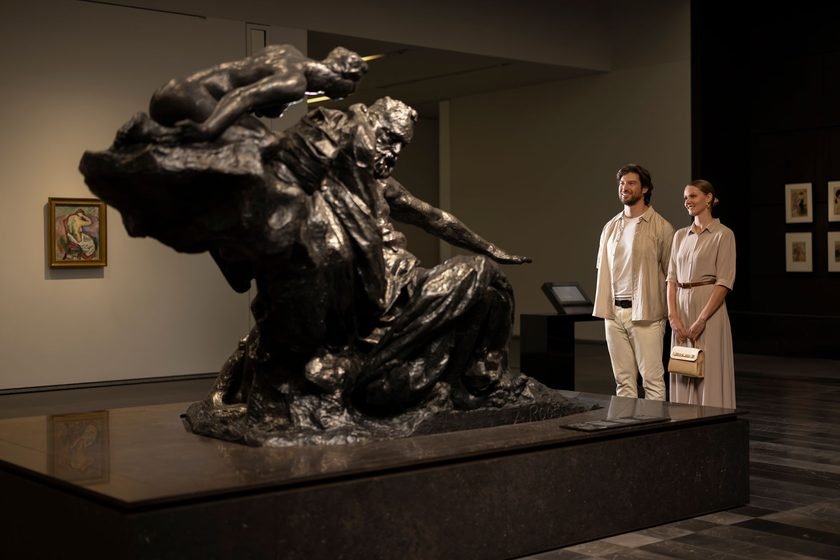
Unlike traditional museums that organise their collections primarily around individual countries, artistic movements or civilisations, Louvre Abu Dhabi adopts a universal approach to art history. Its central philosophy is based on the idea that human cultures have always been interconnected, sharing ideas, knowledge, beliefs, artistic influences and creative traditions across geographical and historical boundaries.
Through this approach, the museum explores the common experiences that unite humanity, presenting objects and artworks from different periods and regions side by side. Its narrative spans from prehistoric times to the contemporary era, encouraging visitors to discover connections between cultures that may initially appear distant from one another.
The museum’s collection encompasses paintings, sculptures, archaeological objects, manuscripts, decorative arts and historical artefacts representing different civilisations and periods. Its galleries present a chronological and thematic journey through human creativity, covering subjects such as the emergence of early communities, the development of major civilisations, universal religions, trade and cultural exchange, the evolution of political systems and the emergence of modern artistic movements.
A distinctive feature of Louvre Abu Dhabi is its international network of cultural partnerships, particularly its collaboration with leading French institutions, including the Musée du Louvre, Musée d’Orsay, Centre Pompidou and other prominent museums. These partnerships have enabled the institution to benefit from loans of important artworks, professional expertise, curatorial collaboration and specialised knowledge in conservation and museum management.
The museum’s collection continues to develop through acquisitions, loans and temporary exhibitions, allowing it to offer visitors new perspectives on art and cultural history.
An Architectural Landmark Inspired by Light, Water and Islamic Design
Beyond its collections, Louvre Abu Dhabi is internationally recognised for its remarkable architecture, designed by the renowned French architect Jean Nouvel, winner of the prestigious Pritzker Architecture Prize.
Inspired by traditional Arabic architecture, particularly the concept of the medina, the museum was conceived as a collection of interconnected buildings arranged beneath an enormous silver-coloured dome. Its design draws inspiration from the relationship between light, shade, water and the natural environment of Saadiyat Island.
The most striking architectural feature is its vast dome, measuring approximately 180 metres in diameter and weighing around 7,500 tonnes. Constructed from eight superimposed layers of geometric metal patterns, it incorporates nearly 8,000 individual stars arranged in a complex design.
As sunlight passes through these geometric openings, it creates the celebrated ‘Rain of Light’ effect, producing shifting patterns of illumination across the museum’s courtyards, walkways and waterfront spaces. The effect is reminiscent of sunlight filtering through the overlapping palm trees traditionally found in the region’s oases.
The result is an architectural experience that combines contemporary engineering with references to the region’s cultural and architectural heritage. Surrounded by water and overlooking the Arabian Gulf, the museum offers visitors an experience in which architecture, nature and art are closely interconnected.
A Global Cultural Platform
Louvre Abu Dhabi plays an important role in the UAE’s broader cultural strategy, particularly in the development of Saadiyat Cultural District as an international centre for museums, education and the arts.
Its mission extends beyond displaying artworks. The institution also organises international exhibitions, educational programmes, cultural events, workshops and activities designed to encourage dialogue between different communities and generations.
It places particular emphasis on education and public engagement, seeking to make art and cultural knowledge accessible to audiences of different ages and backgrounds. Its programmes provide opportunities for visitors to explore artistic expression, understand historical developments and discover the relationships between cultures.
In this context, the new collaboration with Lito Masters represents a natural extension of the museum’s wider vision. By combining digital technologies, scientific expertise and innovative forms of artistic reproduction, Louvre Abu Dhabi is exploring how museum collections can reach audiences far beyond the physical exhibition space.
The limited-edition prints demonstrate how technological innovation can create new possibilities for experiencing art, while reinforcing the importance of preserving the authenticity, cultural significance and artistic identity of original works.
Ultimately, the initiative reflects a broader transformation in the relationship between museums and their audiences: one in which cultural institutions are no longer defined solely by the objects displayed within their galleries, but also by their ability to share knowledge, inspire curiosity and create meaningful connections with people around the world.
TunisianMonitorNews