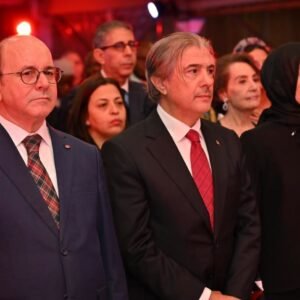
The Indonesian Embassy in Tunisia hosted a diplomatic reception in Tunis to commemorate the 81st anniversary of the Independence of the Republic of Indonesia, bringing together senior Tunisian officials, members of the diplomatic corps, representatives of public institutions, and guests interested in strengthening relations between the two countries.
The Tunisian government was represented at the event by Minister of Health Dr. Mustapha Ferjani, while the reception was hosted by the Ambassador of the Republic of Indonesia to Tunisia, Zuhairi Misrawi, who has been actively working to strengthen bilateral relations and expand cooperation between Indonesia and Tunisia across various fields.
The celebration provided an opportunity not only to commemorate Indonesia’s national independence but also to highlight the country’s rich civilization, cultural diversity, economic development, and growing international presence. It also reaffirmed the importance of the longstanding friendship between Tunisia and Indonesia and their shared commitment to exploring new opportunities for cooperation.
Indonesia: An Ancient Civilization and Exceptional Cultural Diversity
Located in Southeast Asia between the Indian and Pacific Oceans, Indonesia is one of the world’s largest archipelagic countries, comprising more than 17,000 islands. Its strategic geographical position has made it an important crossroads of maritime trade and cultural exchange between Asia, the Middle East, and other regions of the world for centuries.
Indonesia’s history is deeply rooted in ancient maritime kingdoms and trading empires, notably the Srivijaya Kingdom and the Majapahit Empire, which played significant roles in shaping the political, cultural, and historical identity of the archipelago.
Hindu and Buddhist civilizations also left a remarkable architectural and cultural legacy, most notably represented by the Borobudur Temple, one of the world’s most important Buddhist monuments.
With the spread of Islam, Indonesia gradually became the world’s largest Muslim-majority country by population while maintaining considerable religious, ethnic, and cultural diversity.
Indonesian culture is distinguished by its traditional arts, music, dance, craftsmanship, and cuisine. Among its most famous cultural expressions is Batik, the traditional textile art recognized by UNESCO as part of the Intangible Cultural Heritage of Humanity. Traditional Gamelan music and regional dances also reflect the country’s rich artistic heritage.
Indonesian cuisine, meanwhile, offers a remarkable variety of flavours and traditions, with internationally known dishes such as Nasi Goreng and Rendang.
This cultural diversity represents an important element of Indonesia’s international identity and an effective instrument of its cultural diplomacy, helping strengthen mutual understanding and people-to-people relations.
A Growing Economy and an Increasingly Important Role in Asia
Economically, Indonesia occupies a prominent position as the largest economy in Southeast Asia and a member of the G20.
Its economy is supported by a diversified production base that includes manufacturing, agriculture, natural resources, tourism, services, and the rapidly expanding digital sector.
Indonesia is among the world’s leading producers of nickel, coal, natural gas, palm oil, rubber, coffee and spices. Its manufacturing sector has also developed significantly, particularly in automotive production, electronics, and mineral processing.
In recent years, Jakarta has focused on strengthening infrastructure, promoting digital transformation, attracting foreign investment and developing higher-value industries.
Tourism is another important pillar of the Indonesian economy. The country attracts visitors from around the world through its extraordinary natural landscapes, tropical islands, beaches, and cultural heritage, with Bali remaining one of its most internationally recognized destinations.
Looking towards 2045, the centenary of Indonesia’s independence, the country aims to consolidate its position among the world’s leading economies through investment in education, technology, infrastructure, human capital, and industrial development.
Education and Scientific Research: Building Bridges Between Indonesia and Tunisia
Education represents another important dimension of Indonesian-Tunisian relations.
Tunisia has long attracted Indonesian students, particularly because of its academic institutions, historical standing in the Arab and Islamic worlds, and its established traditions in Arabic language studies, Islamic sciences, and humanities.
In statements to the Tunisian TAP News Agency in April 2026, Indonesian Ambassador Zuhairi Misrawi indicated that approximately 500 Indonesian students were pursuing their studies at Tunisian universities, including institutions in Manouba, Ez-Zitouna, Sousse, Kairouan and Tunis.
He also noted that approximately 1,000 Indonesian students apply annually to study in Tunisia, with around 100 being admitted.
These figures underline Tunisia’s importance as an educational destination for Indonesian students and highlight the potential for expanding academic cooperation through university partnerships, scholarships, scientific research, and student exchange programmes.
Such cooperation can contribute to building lasting relationships between the younger generations of both countries and strengthening mutual understanding through knowledge and education.
Tunisia-Indonesia Relations: A Historic Partnership with New Prospects
Diplomatic relations between Tunisia and Indonesia date back to 1960, reflecting a period marked by national independence, state-building, and solidarity among developing countries.
The historical friendship between Indonesian President Sukarno and Tunisian President Habib Bourguiba remains an important symbolic chapter in the relationship between the two nations.
This relationship continued through several high-level visits, including Sukarno’s visit to Tunisia in 1960, Suharto’s visit in 1999 and Megawati Sukarnoputri’s visit in 2003.
Today, both countries are seeking to build on this historical foundation by expanding economic, commercial, and investment cooperation.
According to statements made by Ambassador Zuhairi Misrawi in April 2026, bilateral trade between Tunisia and Indonesia reached approximately USD 350 million, compared with less than USD 100 million in 2022.
Tunisian exports to Indonesia include dates, olive oil, harissa and seafood products, while Indonesian exports to Tunisia include products such as palm oil.
Both countries are also working towards completing negotiations on a preferential trade agreement intended to facilitate commercial exchanges and create new opportunities for businesses and investors.
The development of trade relations represents an important opportunity for Tunisia to strengthen its economic presence in Southeast Asia, while offering Indonesia wider access to North African and Mediterranean markets.
Health Cooperation and Pharmaceutical Industries: Emerging Priorities
Health cooperation and pharmaceutical industries were among the key subjects highlighted during the recent diplomatic reception.
Tunisia’s Minister of Health, Dr. Mustapha Ferjani, emphasized Tunisia’s interest in strengthening its partnership with Indonesia in pharmaceutical industries and biotechnology.
This area of cooperation is particularly significant given the growing importance of pharmaceutical security, local production capacities, technological development and access to modern healthcare solutions.
Potential areas of cooperation include the exchange of technical expertise, technology transfer, joint investment initiatives, and partnerships between pharmaceutical and healthcare institutions in both countries.
Such initiatives could support domestic pharmaceutical production, strengthen healthcare systems, and create opportunities for industrial cooperation.
The development of this partnership would also give bilateral relations a more practical and strategic dimension, extending beyond traditional trade towards sectors directly connected to sustainable development and public well-being.
Tourism and Culture: Strengthening People-to-People Relations
Tourism and cultural exchange offer further opportunities to deepen relations between Tunisia and Indonesia.
Both countries possess remarkable cultural and natural attractions that could encourage greater tourist exchanges and promote mutual understanding.
In his April 2026 media statements, Ambassador Zuhairi Misrawi outlined an ambition to attract one million Indonesian tourists to Tunisia, reflecting the potential of the Tunisian tourism sector to appeal to visitors from Southeast Asia.
Tunisia offers Indonesian visitors a combination of historical cities, archaeological sites, Mediterranean beaches, traditional architecture, and desert landscapes.
Indonesia, in turn, offers Tunisian visitors an extraordinary experience of tropical islands, natural scenery, traditional communities, and diverse cultural heritage.
Cultural diplomacy has also played an increasingly important role in bringing the two societies closer together.
One notable event was Indonesia’s participation as Guest of Honour at the 40th Tunis International Book Fair, held from 23 April to 3 May 2026.
The Indonesian pavilion presented more than 1,000 book titles in several languages, including Arabic, English, French, and Indonesian, alongside intellectual discussions, musical performances, and traditional dance presentations.
This participation provided an opportunity to introduce Tunisian audiences to Indonesian literature, intellectual traditions and artistic heritage, while highlighting the shared cultural interests of the two countries.
It also demonstrated how literature, education and the arts can serve as effective instruments of international dialogue and cultural diplomacy.
The Diplomatic Reception: Celebrating Friendship and Strengthening Partnership
Against this background, the diplomatic reception organized by the Indonesian Embassy in Tunis to commemorate the 81st anniversary of Indonesia’s independence carried significance beyond its ceremonial character.
The event provided an opportunity to renew the historic bonds of friendship between the two countries, review the progress achieved in bilateral relations and explore new avenues for cooperation.
The participation of Tunisia’s Minister of Health, Dr. Mustapha Ferjani, representing the Tunisian government, highlighted the importance attached to expanding bilateral cooperation, particularly in healthcare, pharmaceutical industries and biotechnology.
Meanwhile, Ambassador Zuhairi Misrawi’s role in hosting the occasion reflected the importance of diplomatic engagement in strengthening communication, promoting cultural understanding and developing economic and institutional partnerships.
The reception also illustrated the evolving nature of modern diplomacy, which increasingly extends beyond political representation to include economic cooperation, investment, education, science, technology, tourism and cultural exchange.
For Indonesia, national celebrations abroad provide an opportunity to present its achievements, heritage and development priorities to international partners. For Tunisia, such occasions offer valuable opportunities to strengthen relations with an important Asian partner and explore new areas of mutual interest.
Indonesia and Tunisia: Towards a New Chapter of Cooperation
The celebration of the 81st anniversary of the Independence of the Republic of Indonesia in Tunisia represents an opportunity to reflect on the historical foundations of bilateral relations while looking ahead to their future development.
Indonesia, with its economic weight, demographic strength, cultural diversity and strategic position in Southeast Asia, represents an important partner for Tunisia as it seeks to diversify its international economic relations and strengthen engagement with emerging Asian markets.
Tunisia, meanwhile, possesses important advantages that could support Indonesia’s engagement with North Africa and the Mediterranean region, particularly through education, trade, investment, tourism and cultural exchange.
The growth in bilateral trade, the presence of hundreds of Indonesian students in Tunisian universities, and the growing interest in cooperation in healthcare and pharmaceutical industries all demonstrate the considerable potential of this relationship.
Ultimately, the central message of the diplomatic reception is that friendship between nations is measured not only by the history of their diplomatic relations or the number of official celebrations, but also by their ability to translate that friendship into meaningful partnerships, practical projects and opportunities that benefit their peoples.
The commemoration of Indonesia’s independence in Tunis was therefore more than a celebration of a historic national milestone. It was also a reaffirmation of the shared desire to build a more diversified and dynamic partnership, founded on historical friendship and strengthened through economic cooperation, education, healthcare, tourism and cultural dialogue.
As Indonesia and Tunisia look towards the future, their longstanding friendship offers a valuable foundation for a renewed partnership connecting Southeast Asia with North Africa and the Mediterranean, in a spirit of mutual respect, cooperation and shared development.
TunisianMonitorNews (Douha Essaafi)