Italian orchestra captivates audience with fusion of 17th-century elegance and modern sound in legendary maestro’s final concert
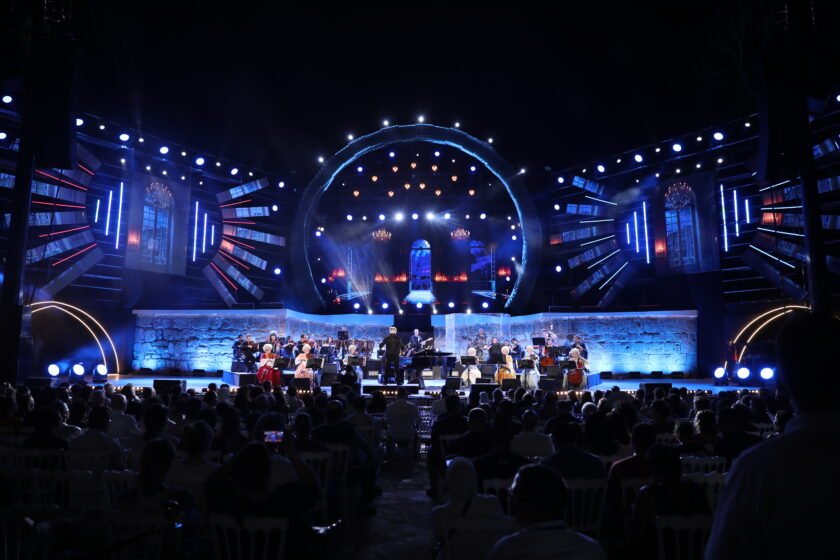
The ancient stones of Carthage’s Theatre echoed with Venetian splendor on August 4 as the renowned Italian orchestra Rondò Veneziano took the stage for an extraordinary evening of music that transcended time and genre.
Under the masterful direction of conductor Gian Piero Reverberi, the ensemble transported the audience on a captivating journey through the Baroque era, their artistic vision perfectly complemented by the majestic setting of Tunisia’s historic amphitheater.
A Revolutionary Vision Born in the Disco Era
Founded in 1979 by composer and conductor Reverberi, Rondò Veneziano has achieved phenomenal global success, with tens of millions of albums sold worldwide. The orchestra draws creative inspiration from the 17th and early 18th centuries, when Venice—home to the legendary Antonio Vivaldi—stood as one of the world’s most influential artistic capitals.
“It was during the era of electronic music and disco in the 1970s that I wanted to create something different,” Reverberi explained during the post-concert press conference. “It was my way of staging a revolution against that trend.”
Spectacle and Sound in Perfect Harmony
The audience erupted in sustained applause as approximately thirty musicians filed onto the stage, including female performers adorned in sumptuous period costumes featuring voluminous ornate gowns and elaborate wigs. Spectators were immediately captivated by the exceptional elegance of the ensembles before a single note had been played.
The musical program opened with “Station di Venezia” (1993), a rhythmically charged composition that immediately established the group’s signature sound—an innovative fusion of Baroque influences with contemporary sensibilities. While Reverberi’s original compositions form the orchestra’s repertoire, many pieces bear striking resemblance to Vivaldi’s concerto movements.
The evening’s emotional journey continued with the softer “Magico Incontro,” followed by “Danza Mediterranea,” featuring a poignant piano solo, and “San Marco,” named after Venice’s most famous square at the city’s historic heart.
Visual Splendor Enhances Musical Mastery
Giant screens throughout the venue projected evocative images and videos of Venetian canals, carnivals, and palazzos, deepening the immersive atmosphere where grandeur, emotion, and refinement left no audience member unmoved.
The maestro himself took to the piano for “Perle d’Oriente,” a remarkably sensitive melody that skillfully wove tender piano passages with sweeping strings and percussion that built to powerful crescendos. The ensemble continued with their eponymous 1980 composition, followed by beloved works including “La Giudecca,” “Casanova,” “Sinfonia per un Addio,” “Marco Polo,” “Misteriosa Venezia,” and other celebrated pieces.
Each performance drew warm acclaim from the audience, whose rhythmic applause merged seamlessly with the music’s cadence, creating a beautiful communion between performers and spectators.
A Bittersweet Finale
The Carthage performance marked a particularly poignant moment in the orchestra’s history—Reverberi’s final concert as conductor before passing the baton to the pianist who accompanied him throughout the evening.
The resounding success of Rondò Veneziano’s concert reaffirms the public’s enthusiasm for diverse musical genres beyond mainstream popular music—precisely the artistic diversity that enriches the International Festival of Carthage.
The festival continues its remarkable program through August 19, promising additional spectacular performances in this iconic setting where history, culture, and music converge.
TunisianMonitorNews