An Interview with the Egyptian Ambassador to Tunisia
Egyptian-Tunisian relations are entering a new phase of growing momentum, driven by closer political coordination and expanding opportunities for economic and institutional cooperation. This rapprochement is increasingly reflected in trade, investment, infrastructure, employment and other areas of mutual interest.
In an interview with Al-Sabah, the Egyptian Ambassador to Tunisia discussed the outcomes of the 18th session of the Egyptian-Tunisian Joint Higher Committee, the prospects for Egyptian investment in Tunisia, and opportunities to strengthen cooperation in technology, digital transformation, agriculture, water security and employment.
The Ambassador also addressed political coordination between the two countries on regional issues, particularly Libya, Sudan and the Palestinian question, stressing that the ultimate objective is to translate political understanding into practical cooperation that benefits both countries and their peoples.
Interview by: Manal Harzi
How would you assess the current state of Egyptian-Tunisian relations, and what distinguishes the present phase from previous stages of bilateral cooperation?
Egyptian-Tunisian relations are founded on deep-rooted historical and fraternal ties, underpinned by strong popular and cultural connections and shared interests.
The current phase is witnessing unprecedented momentum in political communication, alongside serious efforts to expand economic and institutional cooperation. The objective is to translate political rapprochement into practical results in trade, investment, transport, employment, education and other sectors that support sustainable development.
One of the most significant features of this phase is the convergence of the two countries’ visions, at both leadership and popular levels, regarding the importance of upholding the principles of international law, foremost among them respect for national sovereignty.
There is also a shared commitment to protecting Arab national security and preserving the cohesion of states and their institutions in the region, particularly in the face of schemes aimed at undermining stability through internal conflicts and divisions.
This political rapprochement and convergence of positions have already contributed tangibly to strengthening economic and cultural cooperation.
What are the most important bilateral commitments awaiting Egypt and Tunisia in the coming period? Are there any high-level visits planned?
The current priority is to follow up on the implementation of the outcomes of the 18th session of the Egyptian-Tunisian Joint Higher Committee, held in Cairo in September 2025.
Both sides continue to coordinate at various levels, including ministerial meetings held on the sidelines of regional and international gatherings. High-level reciprocal visits by ministers and senior officials take place regularly, whether within the framework of bilateral relations or through participation in meetings hosted by regional organisations based in Cairo and Tunis.
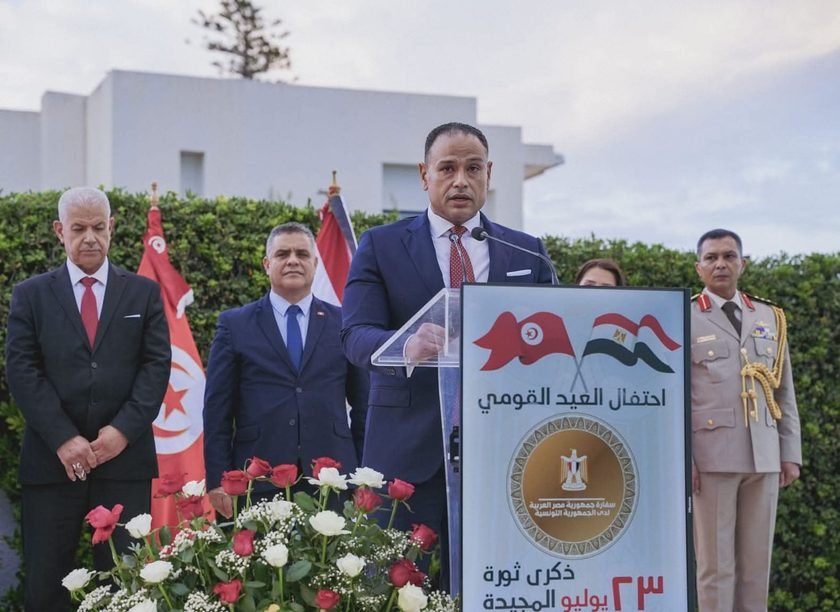
Among the key upcoming commitments are preparations for the next sessions of the Joint Committee for Trade and Industry in Cairo and the Joint Military Committee in Tunis, under the chairmanship of the respective ministers.
A number of technical committee meetings are also being prepared, including those dealing with investment and the mutual recognition of standards and specifications.
The Embassy is likewise following up on preparations for sector-specific technical committee meetings in important trade-related fields, such as consumer protection, supply and domestic trade.
Recent diplomatic activity has highlighted the growing economic and institutional dimension of Egyptian-Tunisian relations, from cooperation between central banks to employment and investment. Does this reflect a new approach to reshaping bilateral relations through a more diversified partnership that goes beyond traditional political cooperation?
Certainly. The high-level directives from the leaderships of both countries are clear in this regard. There is a strong determination to broaden bilateral relations and take them to wider horizons.
The aim is to build on the existing foundations of political cooperation while deepening relations in the economic and cultural fields, and encouraging the private sector to play a more active role in establishing joint ventures that strengthen trade and investment ties and contribute to developing and modernising infrastructure in both countries.
This also includes entering into partnerships to establish joint projects in third countries, making use of the expertise, capabilities and international reputation of major companies from both sides.
Cooperation also involves exchanging expertise in areas such as banking, employment and investment.
The ultimate goal is to ensure that the various areas of cooperation complement one another and that the understandings reached are translated into programmes and projects that can actually be implemented. Work is also under way to prepare memoranda of understanding and new bilateral cooperation agreements in additional fields, further strengthening the existing framework of partnership.
TunisianMonitorNews