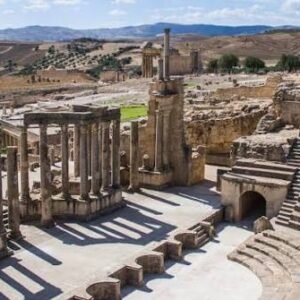
Archaeologists excavating the ancient Punic ports of Carthage have uncovered a Roman-era fortification wall and stone blocks that may have formed part of an ancient breakwater, Tunisia’s National Heritage Institute (INP) announced November 26.
The excavation, launched October 19, 2026, is a joint scientific partnership between the INP and China’s National Centre for Archaeology (NACA), under the supervision of Tunisia’s Ministry of Cultural Affairs.
The wall may belong to the outer enclosure of the central island within Carthage’s famed circular military harbor—once the heart of one of the ancient Mediterranean’s most powerful naval forces. Previous excavations on the island revealed two successive Roman temples and a possible lighthouse structure.
The team also recovered amphorae, oil lamps, pottery, and bronze coins documenting occupation from the Punic period through the Byzantine era.
According to ancient historian Appian, the circular naval harbor accommodated 220 ships, with the central island housing naval command headquarters. Earlier research suggests the harbor and its stone shipsheds were built in the late third or early second century BCE.
Rome destroyed Punic Carthage in 146 BCE, but Julius Caesar and Augustus later refounded it as a Roman colony in 29 BCE. The city became the capital of Rome’s African province, later the Vandal kingdom’s capital, and was captured by Byzantine general Belisarius in 533 CE.
The new discoveries offer a chance to investigate how successive civilizations transformed the maritime complex—particularly the island’s reorganization under Roman rule.
The Punic ports are part of the Archaeological Site of Carthage, inscribed on UNESCO’s World Heritage List in 1979. Excavation and documentation continue as researchers work to reconstruct the harbor’s changing architectural layout.
TunisianMonitorNews